

Background
Location: Little Barford, Saint Neots.
Completion: Ongoing (2023–2025)
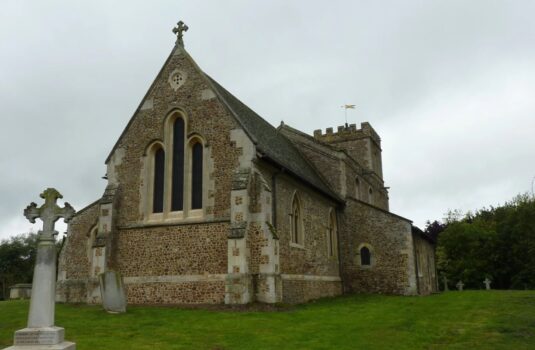
St Denys’ Church is a Grade II* listed parish church of exceptional heritage significance.
Its origins lie in the Norman period, with a C12 south doorway decorated with zig-zag and dogtooth carving, a C14 south arcade and north aisle, and a late C15 west tower. Victorian restorations in the 1860s and 1870s added further layers to its architectural history. Internally, the church retains medieval features including a C13 font, C15 screen, and piscina, alongside C19 stained glass by Kempe.
Hockley & Dawson were commissioned to provide structural advice in regards to the investigation for stabilisation of areas of masonry distress affecting the south and north aisles. Our role was to develop and deliver a conservation-led repair strategy that safeguarded the structure while retaining as much of its historic fabric as possible.
Site Context
• The church sits on a raised platform with a ha-ha to the south, creating exposure to weathering and ground pressures.
• Structural issues were compounded by failed mortars, moisture ingress from defective drainage and flashings, and undermining caused by rabbits and badgers.
• The sensitive historic setting required a carefully balanced approach: ensuring safety and stability without compromising the church’s architectural integrity or its ecological surroundings.
Key Structural Interventions
At St Denys’ Church, structural repairs focused on stabilising two vulnerable corners of the building:
• South Aisle (Southwest Corner): Cracked and loosened stonework was temporarily shored, then carefully dismantled and rebuilt in lime mortar, with monitoring in place and measures introduced to protect against further ground disturbance.
• North Aisle (Northwest Corner): Localised rebuilding was carried out in lime mortar following water damage, with defective copings and flashings replaced, drainage improved, and discreet ground protection added to prevent burrowing activity.
Conservation & Sustainability
• Traditional methods: All works undertaken in breathable lime mortar compatible with historic fabric.
• Minimal intervention: Original stone retained wherever possible; dismantling limited to unstable sections.
• Ecological sensitivity: Wildlife managed with non-invasive measures.
• Future resilience: Drainage and water-shedding enhancements designed to reduce future deterioration risks.
Summary
The St Denys’ Church project showcases Hockley & Dawson’s expertise in the conservation and structural repair of historic parish churches. By combining traditional lime-based construction techniques with discreet modern interventions, we stabilised vulnerable corners of the church while preserving its historic integrity.
This project reflects the specialist skills and judgment required for heritage buildings of national importance, ensuring that St Denys’ Church remains a stable and celebrated landmark within Little Barford’s historic landscape.
